
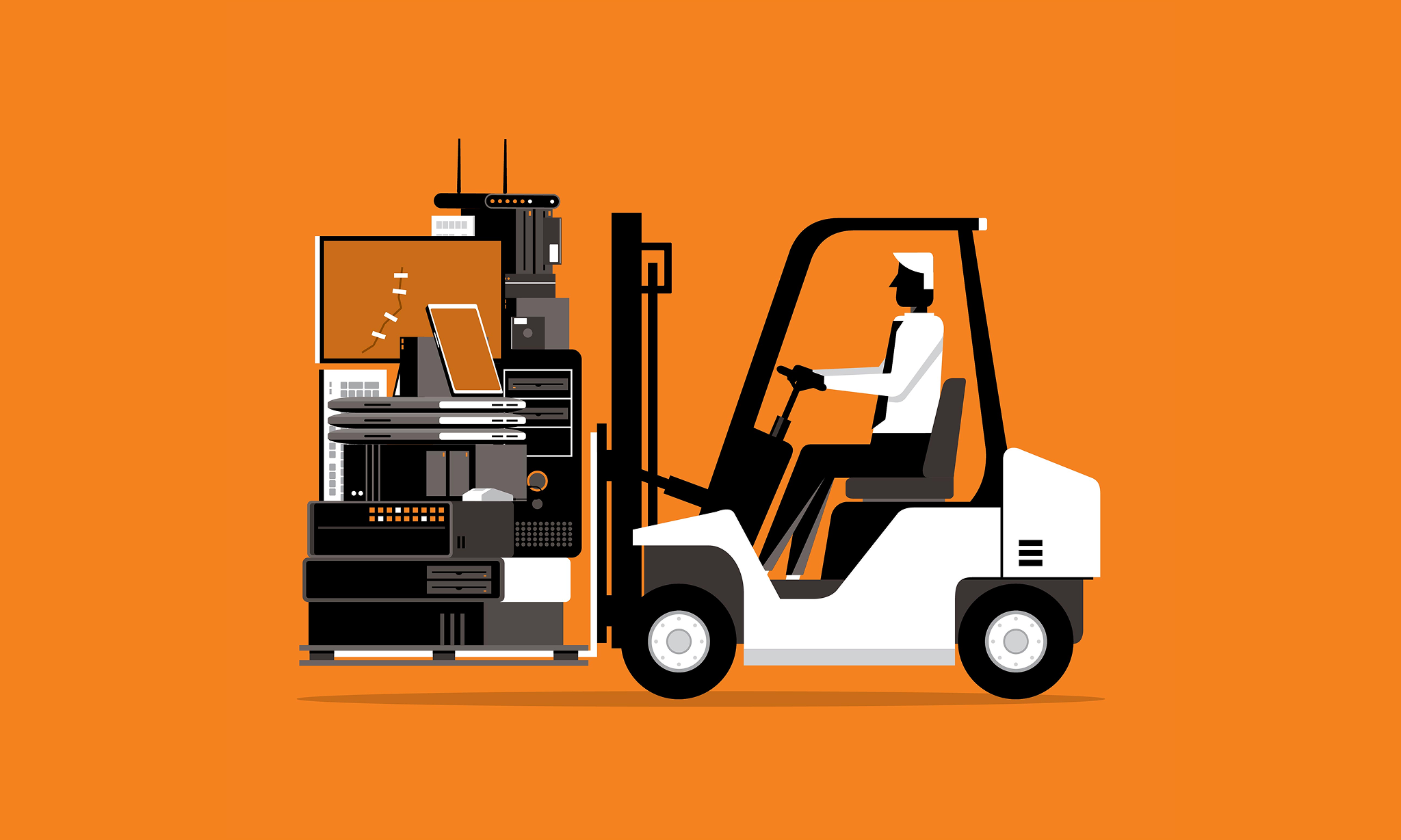
Corporate transitions, such as business mergers, office relocations, or hardware upgrades, inevitably generate surplus tech devices. During the logistics of such a corporate move, integrating a formal IT Asset Disposition (ITAD) strategy into your transition plan ensures that decommissioned equipment does not lead to a data breach while adding value to your disposed IT assets. This structured approach replaces unverified moving methods with a secure, documented process.
In this guide, we provide IT asset managers, CTOs, IT administrators, etc., with a reliable operational checklist for transitions, covering safe equipment uninstallation, secure transit protocols, and verified data destruction. This allows your team to focus on business continuity while ITAD experts like TekNext Global handle the secure clearing of your legacy assets.
What Exactly Is ITAD?
To understand what ITAD is, you have to stop thinking about old computers as trash and start thinking about them as data containers and valuable assets with an extended lifespan.
ITAD is the process designed to solve this. It is a specialized wing of IT management that focuses on the end of a device’s life. It ensures that when a piece of hardware is disposed of, the data is destroyed first, the value is recovered if possible, and the remaining materials are recycled in accordance with environmental laws.
The Anatomy Of Enterprise ITAD
When we consider enterprise ITAD, we are looking at a scale that far exceeds a single office. A US enterprise might manage tens of thousands of devices distributed across multiple locations, states, corporate campuses, and remote home offices.
At this level, the process is defined by enterprise logistics—not simply handing off a few boxes to a local electronics recyclers. It requires a highly coordinated strategy focused on:
- Centralized Tracking: Ensuring full visibility of every asset, whether it’s an on-site server in an Illinois data center or a remote employee’s laptop in Texas.
- Bulk Processing: The operational capacity to securely decommission and clear out an entire corporate data center over a single weekend.
- Regulatory Uniformity: Guaranteeing that assets retired from a branch in Chicago follow the same rigorous data security and environmental protocols as those in New York or Illinois.
The Logic Gate: Refurbish, Recover, or Recycle?
A logic gate is struck when a device enters the ITAD workflow. That’s how the system makes its decisions about your hardware:
The A Stream: Value Recovery (Refurbish)
If a laptop is only three years old and still functions perfectly, it has residual value. The system identifies this and marks it for refurbishment. Data gets removed to military specifications, the computers are reset and cleaned up, and it is then sold to another buyer in the after-market. This helps the enterprise recover some of its initial investment.
The B Stream: Component Harvesting (Reuse)
The system may decompose the broken laptop if the value of the parts is very high. The RAM, the screen, and the specialized chips are taken and fitted into other computers. This is the ultimate form of reuse.
The C Stream: Material Extraction (Recycle)
If it’s old or doesn’t work, it goes to the shredder. But even here, the process is precise. Precious metals such as gold, copper, and palladium are removed from the circuit boards. This not only prevents contamination of the ground with toxic substances like lead or mercury but also returns raw materials to the production process.
The Data Destruction Protocol
One of the biggest misconceptions about ITAD is that a simple factory reset is enough. It isn’t. Professional ITAD services have a three-tier process for data destruction and clear out forever:
- Software Overwriting: This is a method of overwriting the entire hard drive with random gibberish software. This makes the original data impossible to find.
- Degaussing: For older hard drives, a powerful magnetic field is used to scramble the data so completely that the drive will never work again.
- Physical Shredding: Industrial machines take the drive and reduce it to the size of a penny or less. For a business, this is the gold standard when it comes to data security.
Turning E-Waste Into Resources
The ‘Disposition’ element of ITAD is closely related to the planet. E-waste is the fastest-growing waste stream in the world. Enterprise IT asset disposition is one of the solutions to this.
Professional providers like TekNext Global implement a no-landfill policy and provide efficient e-waste recycling services. All components, ranging from the glass in the monitor screen to the circuit boards to the metal used in the frame, are disassembled and returned to dedicated smelters. This keeps your company’s carbon footprint as small as possible, no matter how many IT hardware you add.
The Implementation Matrix
Phase 1: The Inventory Lock
All devices should be programmed into an inventory system before they can leave your building. This is the social part of your governance. All items should be identified by serial number, which helps avoid things getting lost in transportation from the desk to the recycling center.
Phase 2: The Security Logic
This is where secure ITAD takes over. A data destination for each asset type should be determined by your strategy. For example:
- Standard Laptops: Software overwrite (3-pass wipe).
- High-Security Servers: Physical on-site shredding.
- Mobile Devices: Factory cryptographic erasure.
Phase 3: The Environmental Gateway
This is the green earth electronics recycling and disposition phase. A strategy should require that nothing ever be sent to a landfill. Even the plastic outside of a mouse should be put away in a plastic recovery site. Through this gateway, your tech graveyard becomes your resource mine.
Phase 4: The Audit Fortress
Data collection is the last step in the strategy. When the truck leaves, you’re not done! You have achieved success once you have a digital folder with the asset’s lifecycle story. This folder will serve as your fortress against any potential lawsuits, audits, and inquiries about security.
Why Is “Wait and See” a Failed Policy?
Many companies look at ITAD as spring cleaning and do it once a year. This is a formula for disaster in terms of securety of your hardware and software.
Every day, technology is being phased out. When an employee leaves, some screens crack, or a server is upgraded. If you’re not using a formal strategy that’s constantly running in the background, then you’re opening up your back door to external risks.
A strategy is not a project; it is the transition from a company that has some old computers to a company that manages its data assets with military precision.
Why Every Modern Business Needs A Formal ITAD Strategy?
The ITAD market is currently exploding because regulators are finally catching up with technological disposal by companies. In the past, you could get away with simple computer recycling. Today, the market is a complex web of legal requirements and security standards.
A formal strategy allows you to navigate this market as a pro, ensures you work with partners who follow the latest global regulations rather than on-the-fly operations that might dump your data into dangerous hands.
The Green Earth Environmental Mandate
We are moving toward a future where a green earth isn’t just a buzzword—it’s a business requirement. Green Earth Electronics Recycling is a specific approach that ensures your old mercury-filled monitors and lead-heavy circuit boards don’t poison the soil.
An ITAD strategy maps out exactly how your e-waste is broken down into raw materials track vital parts of your corporate environmental footprint.
Closing The Remote Work Security Gap
Today’s office is no longer one building; it’s hundreds of home offices across the country, and the world. Where does a remote employee’s laptop go when he or she leaves your company? If you don’t have an ITAD strategy in place, that laptop, like many others, is lying around somewhere in the kitchen drawer or outdoor garage for months, might run the risk of exposing company secrets.
Avoiding The Headline Risk
There’s not just a fine associated with data breach, but the entire loss of customers’ trust and business. Having an ITAD plan is like your brand’s insurance policy. It makes sure all technology exit paths are protected, logged, and impregnable so that your company is never the narrator of an unwanted story in the news.
Regulatory Compliance As A Shield
From HIPAA in healthcare to GDPR in international commerce, the regulations on data are starting to become tougher and tougher to deal with. These laws are designed to be stringent if the aim is corporate safety, only if the rules were followed.
A formal ITAD plan is a literal shield of documentation. If an auditor calls at your door, you will be able to show a system of organization that demonstrates the proper handling of all assets as per the law.
Managing The Shadow IT Threat
Shadow IT is any software that your company doesn’t officially record–such as a breakroom tablet for checking in, a smart device between meetings, etc. These are usually the worst as they are left behind when upgrading.
For this purpose you need to carry out an audit, which involves locating and eliminating all individual devices, regardless of their size.
The Shift To The Circular Economy
The old system was: buy, break, and bin it. The new one is the circular economy. By having a stringent ITAD strategy, the end of your laptop life is really the beginning of something else.
You help create a sustainable cycle by either repairing other machines with the parts or by melting down the metals and using them for new circuits. This cuts down on destructive mining and puts your business on the right side of sustainable recycling.
What Is A Certificate Of Destruction (COD) And Why Do You Need It
Certificate of Destruction is a legal document provided by an ITAD company. It is like a ‘Death Certificate’ of data-bearing devices. It categorically states that particular parts of a system have been processed and that information no longer exists in any physical or electronic form.
However, a real COD in the enterprise ITAD is more than just a piece of paper saying we destroyed it. A forensic-grade COD contains the following:
What’s in a Certificate of Destruction
- The Serial Number Scan: An identifier that indicates each hard drive or device.
- Method of Execution: If the device is wiped using 3-pass software, degaussed (magnetically scrambled), or physically shredded.
- The Time-Stamp: The precise time and date at which the data would not be recoverable.
- The Custodian Signature: The name of the certified technician who oversaw the destruction.
Why Trust Is A Liability In The ITAD Market?
There are many recyclers out there that will pick up all your IT equipment for free. Many businesses believe that they are being efficient in turning over old PCs to these organizations.
If that recycler sells your wiped laptop and the next guy who buys it discovers your company’s payroll spreadsheets, it is NOT the fault of the recycler. The law blames you. You are the Data Originator, and only when you get your hands on the COD do you legally own the data. That liability is transferred from your company once the COD has been issued. That’s why researching and finding the right kind of ITAD partner you can trust is worth the effort.
Layer 1: The Security Shield
The first reason you need a COD is pure security. We often think of data breaches as hackers in hoodies breaking into servers. In reality, a 42 percent of data breaches happen because of lost or disposed hardware.
When you engage in secure ITAD, the COD serves as your shield. It proves that the chain of custody was never broken. It shows that from the moment the laptop left your employee’s hands to the moment it was dropped into an industrial shredder, it was tracked.
If an auditor asks about the hard drive from the laptop assigned to the CFO in 2024, your COD provides the forensic answer.
Layer 2: The Environmental Paper Trail
The regulations for green earth electronics recycling and its asset disposition are extremely strict nowadays. Mercury, lead, arsenic, and cadmium found in laptops if found and end up somewhere other than safe disposition location, could result in fines.
The COD usually has a green component: it guarantees that the non-data elements of the device—plastic, glass, and heavy metals—were disassembled in a certified green earth electronics recycling and ITAD plant. This helps prevent association with e-waste exports to developing countries or illegal dumping by companies.
Digital And Instant CODs
Real-time tracking is a new trend we are seeing in ITAD. You’ll soon be able to watch a real-time visual feed of your specific hard drive being destroyed, and receive the COD the moment that destruction is complete.
That’s the level of transparency that’s now expected. Purchasers, investors, and partners want to know that you also take green earth electronics recycling and ITAD seriously.
Offsetting Relocation Costs with Value Recovery
Implementing enterprise ITAD solutions can yield value recovery, allowing you to sell those obsolete networking devices or old laptops so you can recover profit and even the moving costs.
Every office is not the same, and a professional partner can provide you with a fair market value report on an old office before you’ve even had to start packing!
Avoiding Emergency Disposal Fees
Those emergency fees are what you have to pay if you call an ITAD company the day before your lease is up.
It is helpful to coordinate ITAD as part of your move plan 90 days before moving, as this helps you negotiate better rates and a smoother pickup schedule.
The Financial Benefits Of IT Asset Value Recovery
Transforming Depreciation Into Liquid Capital
Your desk/laptop computers and servers are losing value every day. Most businesses are forced to replace these units, at brick value, which basically equates to the device’s worth being zero.
A value recovery ITAD strategy is the process of defining the sweet spot, the time when your device also has a large secondary market demand, but not one that would classify it as the cutting edge for your team. When you get rid of IT assets, you aren’t getting rid of something that has lost its value; you’re converting it into cash that you can quickly use for the next IT asset refresh.
Offsetting The New Tech Price Tag
The price of enterprise IT hardware is increasing. So, whether you are purchasing high-end laptops or high-density servers, the shock is there. The value recovery is an inherent discount.
The net cost of your new stock is reduced by the net cost of retiring 500 laptops that have a lot of remaining value when you receive the pay back from your ITAD partner. This helps your department keep up to date with the latest tech without constantly requesting huge budgets.
Reducing Total Cost Of Ownership (TCO)
The total cost of ownership of a laptop isn’t just the purchase price; it’s the purchase price plus maintenance, minus the final resale value. Without a value recovery plan, your TCO is much higher.
By working with a secure ITAD partner who specializes in resale, you maximize that final cut. This makes your IT department look more efficient on paper and proves to the CFO that you are managing the company’s physical assets with the same precision as a stock portfolio.
Eliminating Invisible Storage Costs
The Total Cost of Ownership (TCO) of a laptop is not simply the total cost of buying and owning, but rather the total cost of buying and owning minus the total resale value of the machine.
When you don’t have a value recovery plan, your TCO is significantly higher. Working with secure IT asset disposition partners with specializations in remarketing will maximize that last subtraction. This boosts your IT department’s on-paper efficiency and assures the CFO that you’re holding the company’s physical assets in the same hand as a stock portfolio.
Finally
Consider ITAD more than just a ‘tech chore’—it’s the responsible last chapter of your equipment’s life story. You’re not only organizing your discarded tech, you’re doing it in a secure, sustainable way, which is good for your customers’ privacy, the environment, and your wallet.
Proper care and maintenance of your hardware indicate that your business values integrity both in its start and finish. It’s an easy way to be safe, compliant, and green.
FAQs
Only materials such as plastic or metal are typically recycled. ITAD is a comprehensive solution that involves data security, legal adherence, and recovering funds from used equipment.
Data is destroyed either using specialized software that overwrites the files or physically by industrial shredding. These data destruction techniques make it impossible for even advanced hackers to retrieve any legacy data.
No, because simple formatting does not delete files but simply hides them; it is very easy to recover your data. Professional ITAD experts ensure the data is completely wiped off and irrecoverable.
By fully recycling all of the devices, it prevents toxic materials such as lead and mercury pollution that might otherwise end up in landfills. This helps create a “circular economy” in which old parts are reused to create new machines.
Most bulk pickups are documented, processed, and wiped within 30 days of leaving your facility. Final reports and certificates will be sent to you upon complete verification of data sanitization. However, this all depends on the inventory, location, age of your hardware, and sanitization methods.