
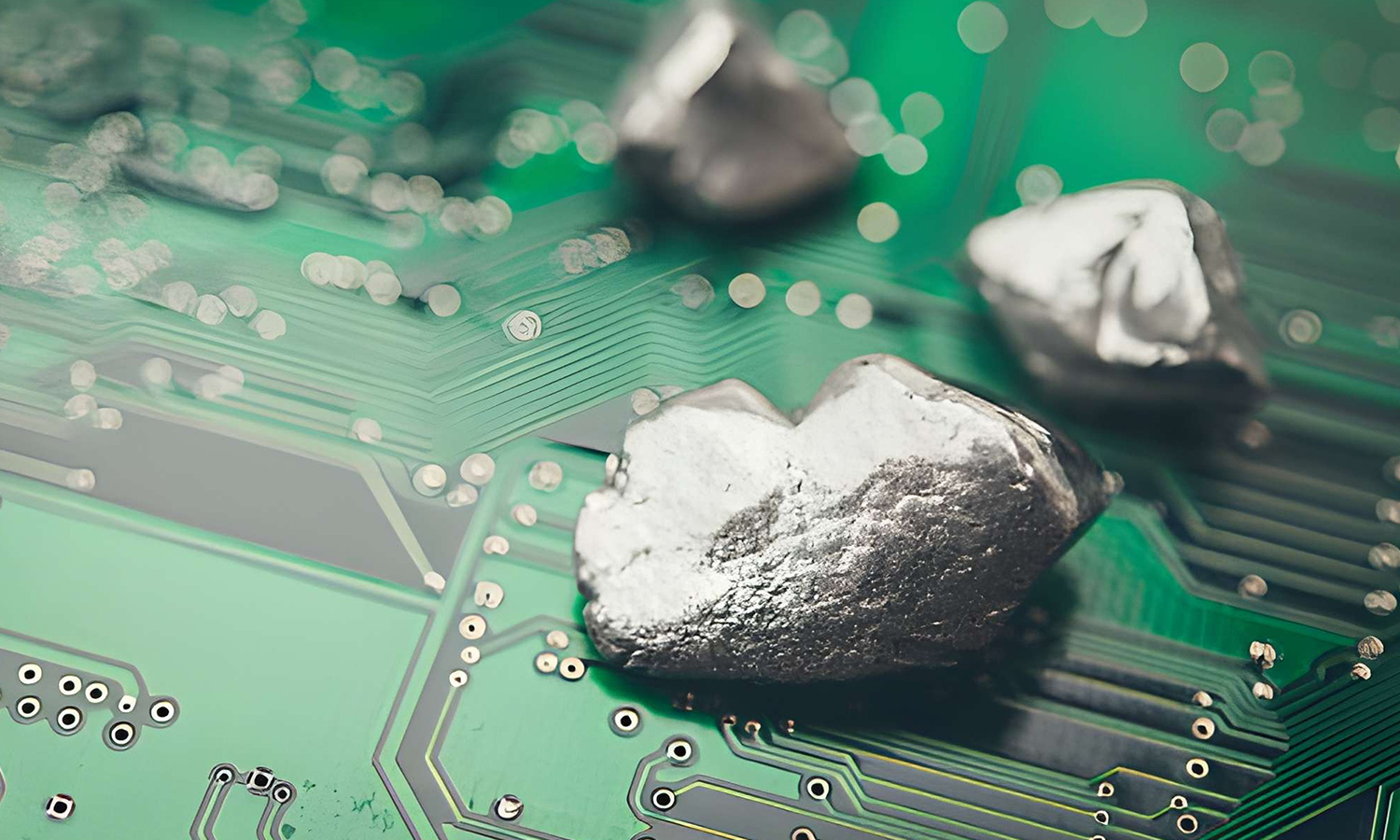
More than plastic, glass and metal are discarded electronic waste. Valuable materials in the electronics, energy and manufacturing industries can be present in old computers, hard drives, displays, circuit boards and rechargeable batteries. Some of these include rare earth elements, precious metals, and critical battery materials.
The ability to recover these resources can help fill in gaps in primary raw materials and lessen the amount of usable material that is lost in improperly disposing of electronics. Understanding e-waste recycling for businesses and enterprises is an important step toward managing discarded electronics responsibly.
However, recovery is not as simple as extracting every valuable element from a mixed pile of devices. It depends on identifying the right components, separating materials efficiently, and using suitable processing technologies.
Rare Earth Elements vs. Critical Materials: What’s the Difference?
The term rare-earth elements and/or critical materials are used interchangeably in the context of e-waste recycling, but they refer to different resource groups.
The rare earth elements (REEs) are 17 elements, including the 15 lanthanides, scandium and yttrium. They are used for permanent magnets, some types of display technology, and a few lighting systems because of their special magnetic, optical and electronic properties.
Materials that are critical are determined by their economic significance and supply risks. The classification differs from country to country and may be subject to change in accordance with the technology, demand and supply conditions.
Examples of materials considered critical in various jurisdictions include:
- Rare earth elements: Used in permanent magnets, selected electronic components, and specialised optical applications.
- Battery materials: Lithium, cobalt, and nickel, which are used in certain rechargeable battery chemistries.
- Specialty metals: Gallium and indium, which are used in selected semiconductors, displays, and other electronic technologies.
- Precious metals: Gold, silver, and palladium, which are valued for their electrical properties and use in electronic contacts and circuit boards.
These categories do not necessarily intersect but cannot be substituted. Not all critical materials are rare earth elements, and not all of the discarded electronic devices contain recoverable amounts of these materials.
To the electronics recycling industry, the important consideration is which materials are found in what e-waste stream and whether they are sufficiently concentrated and in such a condition that re-processing makes good economic sense.
What Rare and Critical Materials Can Be Recovered from E-Waste?
There are various groups of materials in e-waste that have different properties and recovery needs.
Rare Earth Elements
Rare earth elements are incorporated into products that depend on their magnetic, optical or electronic properties. Neodymium is found in high-quality permanent magnets in some hard drives and speakers and other electronic devices. Some magnets are made with dysprosium as an ingredient to enhance their function at higher temperatures.
Other rare earth elements such as yttrium, europium and cerium are used in specific display, light and phosphor technologies. Their occurrence is related to the product type and manufacturing generation. They can be difficult to recover, because they may be embedded in small, complicated metal parts.
Precious Metals and Other Critical Materials
Other valuable materials are also found in electronic waste:
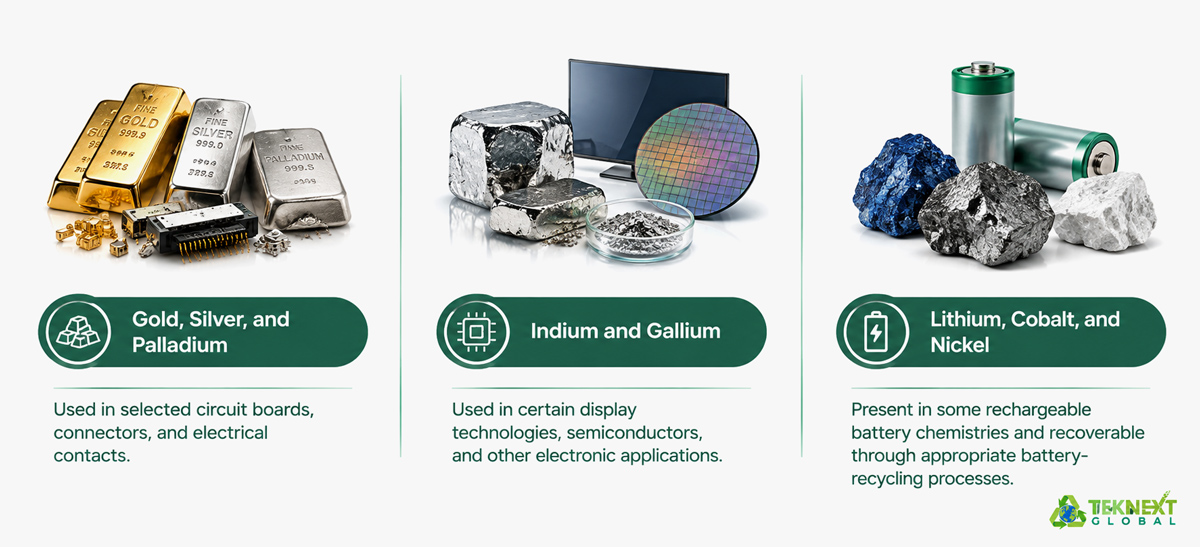
- Gold, silver, and palladium: Used in selected circuit boards, connectors, and electrical contacts.
- Indium and gallium: Used in certain display technologies, semiconductors, and other electronic applications.
- Lithium, cobalt, and nickel: Present in some rechargeable battery chemistries and recoverable through appropriate battery-recycling processes.
These materials should not be treated as one recovery category. Each requires processing suited to its chemical properties and the waste stream in which it is found.
Which E-Waste Streams Offer the Best Recovery Opportunities?
An professional e-waste recycler like TekNext Global can recover a variety of materials, depending on the type of waste equipment that is discarded.
The composition and design of Printed Circuit Boards (PCBs) varies according to the amount of copper and other precious metals they contain. The metal-rich fractions can be concentrated to specific recovery processes.
Neodymium-based permanent magnetic materials can be used in hard drives or magnetic components. It may make rare earth recovery more feasible if these magnets can be separated prior to general processing.
Depending on the technology, displays and lighting wastes can contain indium or rare earth containing phosphors. There are various types of displays, and the materials used in older types differ in composition from the newer flat-panel displays, so each type should be identified and handled accordingly.
Recovery opportunities are available for rechargeable batteries. Lithium-ion and nickel metal hydride batteries do not have the same chemistry and should be separated from each other and not treated as one material stream.
The first step is to identify and focus on the components with target material and then choose the recovery method.
How Rare Materials Are Recovered from E-Waste
Recovery generally involves several connected stages, from separating useful components to extracting and purifying the target materials.
1. Collection, Sorting, and Component Separation
Electronics recyclers will first determine the equipment that can be used and then sort it into a stream of materials. This can be anything from batteries, circuit boards, hard drives, magnets, or display parts.
It’s a crucial stage because mixed e-waste may include plastics, glass, metals and other materials that could pose difficulties in the subsequent processing stages. The separation of relevant components helps to improve the quality of the feedstock and to avoid loss of valuable materials in unsuitable waste streams.
2. Mechanical Processing and Concentration
Dismantling, shredding, screening and physical separation may be performed on selected components. These techniques are used to decrease the size of the material and to bring together fractions which contain the desired metals.
The exact process is dependent on the feedstock. The processing of circuit boards, for instance, might be for the purpose of separating out the metal-rich portions of the nonmetallic components, or the recovery of the magnets themselves by magnet processes might be looking to preserve and isolate the magnets.
Mechanical processing is done to prepare the material for extraction, but does not necessarily yield pure metals.
3. Metal Extraction and Separation
Once prepared, certain materials are recovered from the waste by special facilities using chemical, thermal or other processes.
- Hydrometallurgy: Dissolves desired metals using appropriate chemical solutions, and then separates and purifies the metals. It has a large number of uses in rare earth recovery from magnets, batteries, and other E-waste.
- Pyrometallurgy: High temperature treatment of suitable streams of material to recover some metals. It is effective based on the elements to be targeted and the design of the process.
- Biohydrometallurgy: Uses biological processes, including microorganisms, to help mobilize or recover particular metals. Numerous methods are still in the research and/or development phase.
Further treatment may involve precipitation, solvent extraction, or electrochemical techniques to separate and purify recovered materials. No single method is ideal for every e-waste stream; the appropriate route depends on the composition of the feedstock, recovery objectives, and environmental controls.
Why Rare Material Recovery in E-Waste Recycling is Challenging
The presence of valuable elements does not automatically make recovery economically or technically practical.
Low Concentrations and Complex Product Designs
Some materials occur in very small quantities and are dispersed across components containing multiple metals, plastics, ceramics, and adhesives. Extracting them selectively can require additional processing and separation.
Cost, Purity, and Recovery Efficiency
Collection, dismantling, energy, chemicals, and purification all contribute to the final cost. Recovered material must also meet suitable quality requirements before it can be reused in manufacturing. A process that extracts an element successfully at laboratory scale may not be economical at industrial scale.
Environmental Controls
Chemical extraction can generate wastewater and residual materials that require treatment. Thermal processing also requires suitable energy controls, energy emissions and process controls. Responsible recovery relies on the control of environmental effects of the process, in addition to maximizing the extraction of materials.
The research reviews are still relying on commercial viability, process integration and scale-up as critical challenges to the recovery of rare earths on a larger scale from e-waste.
How Expert E-Waste Recyclers Improve Rare Material Recovery Rates
The better the recovery, the sooner you start. Designed to be easily disassembled, these components can be removed with ease. Improper sorting can cause e-recyclers to send magnets through the wrong processing lines, resulting in lower quality returns and greater costs.When sorting is poor, e-waste recyclers may be sending magnets through the wrong lines, leading to higher costs and lower quality returns.
Specific chemical treatments can also minimize material loss by matching the treatment process to the many streams by using specialized recyclers. There are documented instances of down stream processing and adequate environmental controls to ensure that recovered materials will be handled responsibly.
Lastly, ongoing research and development of selective extraction and purification techniques may lead to increased recovery efficiency and identification of techniques suitable for commercial applications.
Environmental and Resource Benefits of Rare Material Recovery
Recovering valuable materials from electronic waste can help conserve resources and reduce the amount of usable material lost through inappropriate disposal. Recovered materials may be used in manufacturing when they meet the requirements of manufacturing, and can supplement materials obtained from primary mining and processing.
The potential benefits include:
- Better use of existing resources: Metals already incorporated into electronic products can become secondary raw materials instead of being discarded.
- Reduced dependence on primary materials: Recovered metals can supplement newly mined resources, although the extent depends on recovery rates and market demand.
- Improved material circularity: Effective collection and processing help keep suitable materials within manufacturing supply chains.
- Less avoidable material loss: Separating valuable components before general processing can help prevent some recoverable materials from entering unsuitable waste streams.
However, e-waste recycling does not automatically produce a net environmental benefit in every situation. Collection, transportation, energy use, chemical treatment, and residue management all have environmental impacts. There are environmental effects associated with the collection, transport, energy consumption, chemical treatment and residue management. Result will be influenced by the efficiency of the recovery process and by the control measures as regards emissions and waste.
There is also no complete replacement for mining.There is also no total replacement for mining through recycling e-waste. Some materials are found in low levels, some are technically hard to separate at an economic cost, and the amount of material that can be recovered is dependent on the amount of material that is available at a recycling facility and the costs of suitable equipment.
These best outcomes are achieved by a combination of good collecting, proper material separation, effective processing, and responsible handling of the materials and residues produced.
Conclusion
Rare material recovery is the process of recovering valuable materials from selected streams of eWaste. Effective results need to be achieved by identifying those components that contain material, separating them correctly and implementing recovery operations that are appropriate to the feedstock. The more technologically sophisticated today and the more economically viable the processing becomes, the more we can expect to see responsible e-waste recycling helping to keep critical materials in circulation.