
ITAD (IT Asset Disposition) is the process of managing, refurbishing, reselling, or recycling IT equipment that a business no longer needs. E-waste recycling, on the other hand, means breaking down assets into parts that can be recycled or disposed of safely.
Every organization that replaces large numbers of assets like desktops, keyboards, and printers has to deal with the challenge of their disposal. Some items can be reused or resold, while others have to be recycled or permanently destroyed.
A Capterra survey conducted in 2023 found that, among organizations with an ITAD process, 80% recycle at least some of their IT hardware.
While both processes are about retired assets, they still serve a unique purpose. Let’s take a look at key differences between ITAD and e-waste recycling.
Key Differences Between ITAD and E-Waste Recycling
This is where ITAD and e-waste recycling differ. ITAD is a process that manages assets from pickup and data security through disposition of IT equipment, and final reporting, with assets routed for reuse, resale, recycling, and secure data destruction. E-waste recycling is about recovering materials from retired assets that have reached the end of their useful life and final disposal downstream.
What Happens to the Equipment
ITAD
ITAD experts inspect the retired assets to decide their final route. Outdated assets are inventoried, inspected, and graded before their final disposition is decided.
Equipment with remaining useful life may be redeployed, repaired, refurbished, remarketed, or sold. Assets that do not have enough life or value are sent for parts recovery or recycling.
For example, if an organization retired 500 desktop computers, an ITAD service provider does not treat all 500 as waste. Some may be in good enough condition to resell, while others may require repair, and some may be too damaged and may be recycled.
This framework aligns withEPA’s electronics stewardship hierarchy, which prioritizes reuse, refurbishment, and repair over recycling. Extending a product’s life reduces the need for new materials and manufacturing.
E-Waste Recycling
E-waste recycling is about equipment that has reached its useful life or is too worn out to be recovered. Therefore, an e-waste recycler collects, processes it–the equipment is dismantled, sorted, and processed to recover materials such as copper, steel, aluminum, plastics, glass, and more.
Learn More: The Ultimate Guide To E-Waste Recycling For Businesses And Enterprises
How is Data Handled
ITAD
Data security is the core of the ITAD process. Before a device is sent for further processing, the storage media is sanitized using an appropriate method like data wiping, shredding, or physical destruction.
The method is chosen depending on factors like media type, sensitivity of the information, and whether the device will be reused or destroyed.
NIST SP 800-88 Rev.2, published in September 2025, says that media sanitization should make data inaccessible for a reasonable amount of effort. It also suggests having an organization-wide sanitization program and selecting appropriate methods based on information sensitivity.
E-Waste Recycling
The primary purpose of e-waste recycling is material recovery, not managing the organization’s data lifecycle. Sending equipment to a recycler doesn’t automatically mean they’ll handle the data securely. An asset might be physically dismantled while its storage may contain recoverable data. When a data-bearing asset is routed for recycling, the organization should know who is responsible for data sanitization, what method is used, and how the process is verified.
How is Value Recovered
ITAD
The value comes from the retired asset itself.
The retired equipment is evaluated, and based on its condition, the equipment is either reused or resold. Factors like age, specifications, and repair requirements are considered to draw the final conclusion.
E-Waste Recycling
The value is recovered from the materials and components inside the device.
An asset that may have little or no resale value as a complete device may still contain materials like copper. These materials are separated using different techniques and sold to manufacturers and recycling companies. For example, a U.S. wire and cable manufacturer, Encore Buyer, buys insulated wire and bare copper from customers to use in its manufacturing operations.
ITAD evaluates the asset for its highest-value disposition, while recycling focuses on material recovery.
What Gets Tracked
ITAD
ITAD provides records from the point at which the asset departs the organization through its final disposition.
Records generally include:
- Asset tag and serial number
- Equipment type and model
- Condition and grade
- Data-bearing status
- Sanitization method
- Resale or reuse outcome
- Recycling or destruction route
- Final disposition
E-Waste Recycling
Recycling records are about materials processed and the recycling outcome. Documentation may include:
- Equipment categories
- Weights
- Material recovery
- Downstream processing
- Recycling certificates
| Comparison Factor | ITAD | E-Waste Recycling |
| Key purpose | Refurbish, resell, remarket, or reuse equipment | Recover materials |
| Equipment condition | Has remaining useful life and assets are in working condition | Equipment has reached the end of its useful life and cannot be reused |
| What happens to the equipment? | Depending on its condition, a final disposition route is selected | Assets are dismantled to recover materials like copper, steel, etc. |
| Data security | Data is sanitized before assets are passed on for the next step. ITAD provider manages this step. | Focuses on material recovery; data handling must be confirmed separately. |
| How is value recovered? | By reselling, refurbishing, or recycling | Through material recovery such as aluminum, copper, plastic, etc. |
| Asset tracking | Asset tag and serial number, sanitization method, condition, etc. | Equipment quantity, materials recovered, and recycling outcomes |
| Best suited for | Equipment that is in reusable condition | Equipment that has no remaining value |
How are ITAD and E-Waste Recycling Connected?
ITAD and recycling are not competing choices; rather, recycling can be one of the final steps within an ITAD process. An organization may send a batch of retired equipment to an ITAD provider. The provider can sort the devices and send each one down the most appropriate route:
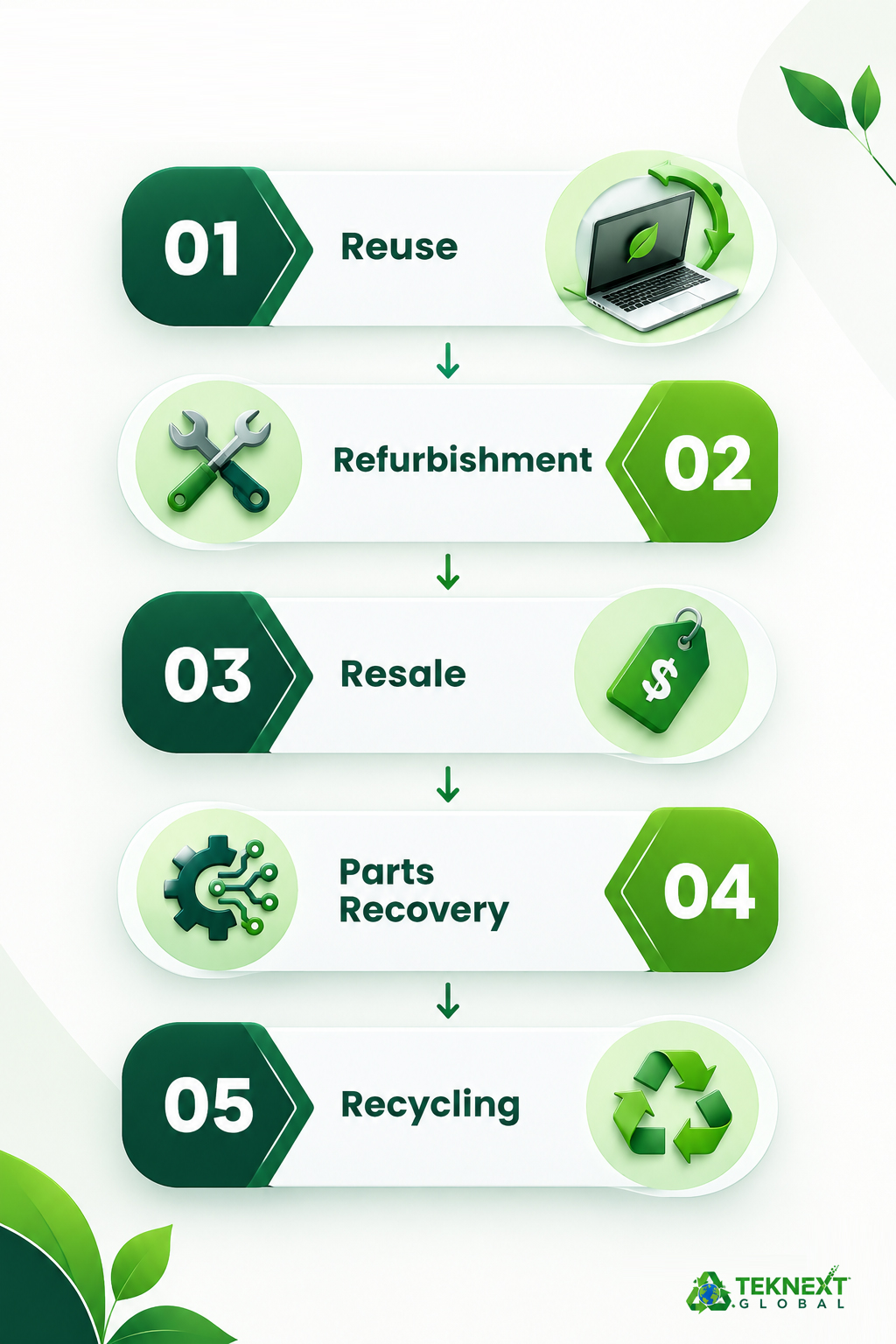
This ensures that organizations receive the full value of their equipment rather than treating outdated assets as waste just because they no longer need them.
Conclusion
ITAD and e-waste recycling serve unique purposes, but they can work together. ITAD’s primary goal is to find the best outcome for retired assets. The outcome could be reuse, resale, refurbishment, parts recovery, or recycling. E-waste recycling focuses on recovering materials when equipment is no longer useful as a complete product.
For organizations, the right choice varies based on the condition, value, and data sensitivity of their assets. Rather than treating every asset as waste, it is better to evaluate each asset first to reap its full value.
Frequently Asked Questions
Which one is better for a business? ITAD or E-waste recycling?
It depends on the condition of the equipment. If the retired asset has reached the end of its useful life, it is better to opt for e-waste recycling. But if the assets can either be reused or resold, ITAD can help determine the best disposition route. For a better understanding, companies should consult an expert to decide between ITAD and e-waste recycling.
Can an ITAD provider pick up equipment from multiple locations?
Yes, many professional ITAD providers offer pickup from multiple offices and data centers (including TekNext Global). They provide asset-level records that help organizations keep track of the equipment. This allows businesses with equipment across different locations to manage everything through one ITAD program rather than arranging separate disposal services at each site.
What should a business do before handing over equipment to an ITAD provider?
Organizations should identify the equipment, separate any assets that require special handling, and confirm which devices contain data. In case of important data, organizations should back up the data or provide relevant data handling requirements to the ITAD provider.
How do businesses know where their recycled equipment ended up?
Businesses can ask their ITAD or recycling provider about its downstream processing partners and where collected equipment is sent. Providers may also provide recycling certificates, processing reports, and information about the facilities handling the equipment.